I have had a couple of things rattling around in my mind on which to comment, including the misguided decision by Rolling Stone magazine to make a pseudo-rock star out of Boston marathon bomber Dzhokhar Tsarnaev, in an attempt to be provocative, by putting his picture (in a Jim Morrison-like pose) on its cover. That is bad enough, and I completely disagreed with it, but I decided to direct my comments in a different direction.
It was two weeks ago today that the verdict was handed down in the George Zimmerman trial for the murder of seventeen-year-old Trayvon Martin, in which his defense was Florida's "Stand Your Ground" law. The law states that anyone who feels directly threatened to the point of their life being in imminent danger may fire a weapon at their aggressor. A jury of six women returned a verdict of not guilty to the charge of manslaughter. To say it was a controversial decision would be an understatement.
It was a controversial verdict for several reasons. First, a number of things, brought up and not brought up in the trial, pointed to Zimmerman's guilt. Those included his not really being on a neighborhood watch patrol, carrying and using a weapon while "on watch" (Florida's law allowing the carrying of firearms is irrelevant to this point), and willfully ignoring the 911 dispatcher telling him to not follow Martin. The only major point of dispute, in my mind, was a recording of someone else calling 911, in which screaming for help is heard in the background...the screaming stops as soon as the gun goes off. Was it Trayvon Martin or George Zimmerman screaming for help? (To me, it truly sounded like someone younger screaming, so I believe it was Trayvon Martin, but it was admittedly hard to tell.)
To that point of dispute, it could have been Trayvon screaming for help just as likely as it could have been George Zimmerman screaming for help. We weren't there, but why is it impossible to accept that perhaps George Zimmerman was screaming for help because Trayvon Martin was scared and defended himself?
Zimmerman followed Martin, which included him getting out of his car to do so, which makes Zimmerman the aggressor.
Second, there was a racial factor, real or manufactured, to the verdict. The five female jurors broke out this way: five white, and one Hispanic. George Zimmerman is Hispanic and has a fair complexion. Some Hispanics, certainly not all but some, have a somewhat darker complexion. Zimmerman's complexion is quite fair, not a rarity among the Hispanic community, which led some people to refer to him as a "white-looking Hispanic" or simply a "white Hispanic". Why did just "Hispanic" seem insufficient to some people?
Many people felt that, to put it bluntly, the almost all-white jury let a Hispanic man who was fair-skinned off the hook for murdering a black teenager. The response to that verdict has shown the racial divide that still exists today. To anyone who feels that it didn't show that divide, but merely created a new one, or created an opportunity (and I'm getting blunt again here) to allow black Americans to get "uppity", let me contrast this verdict with another one from last year...also in the state of Florida.
Marissa Alexander had remarried, but the relationship between her and her second husband, Rico Gray, was a physically abusive one. Both she and Gray had restraining orders against one another. In a physical altercation on August 1, 2010, that escalated to Gray threatening no one was going to have Alexander if he couldn't, Alexander got away from Gray and went into the garage to retrieve her gun from her car's glove compartment. She re-entered the house -- which, in and of itself, makes her ill-advised decision to cite Florida's "Stand Your Ground" law invalid -- and fired a warning shot in the house when he refused her demand for him to leave. On May 11, 2012, Marissa Alexander was sentenced to twenty years in jail for aggravated assault.
Marissa Alexander is black.
In both instances, Florida's controversial "Stand Your Ground" law was cited. Neither George Zimmerman nor Marissa Alexander really could lay claim to the law. Even if Trayvon Martin did physically attack Zimmerman, which it appeared he did, Zimmerman was the initial aggressor. It was his actions that started the chain of events leading up to Martin's murder. Period. If Marissa Alexander was so scared of her husband, and if she was able to get away from him, she should have left the property. Period.
Kill someone, get off. Fire a warning shot that hits no one, get twenty years in jail. I know Lady Justice's eyes are blindfolded and she holds the scales of justice, but these two cases show a clear imbalance. Just as these two cases had "Stand Your Ground" as their basis, it is Florida's "Stand Your Ground" law that is the basis for the imbalance here. The law must be repealed.
Terry
Saturday, July 27, 2013

Saturday, July 13, 2013
Phrase of the Day: THEY FAILED
An eleven year old girl with dreams and aspirations talks about what she wants to be when she grows up. She wants to go to school to become a doctor. As many eleven year olds are, she is vocal about going to school to become a doctor. After a while, pretty much everyone in the town knows about it.
However, she is met with resistance. Not the kind of resistance you might think of (i.e. being told she's not good enough, lack of money, lack or denial of financial support), but something far worse. On October 9th of last year, when the girl is fourteen, on a school bus heading home, she was shot in the head and neck...just for wanting to be educated.
The eleven year old girl is Malala Yousafzai, a Pakistani girl who stood up to oppression and subservience.
Under the iron fist of the Taliban, girls wanting to be educated are forced into secrecy, with both them and their teachers risking death every day in doing so. The school she attended, run by her father, was one of the final underground schools that defied Taliban orders until it was forced to close.
Malala's persistence gained her growing recognition, as well as growing resentment from Taliban leaders. From outside of the Taliban, her efforts earned her respect and admiration. From the Taliban, her efforts gained her a bullet to the head that almost ended her life. There is no doubt a documentary about her that was filmed three years before her being shot brought even more attention to her cause.
After being shot, she was treated at two military facilities in Pakistan: one just over 100 miles (168 kilometers) from where she lives, the other just over 150 miles (247 kilometers) from home. Six days after being shot, she was moved to Queen Elizabeth Hospital in Birmingham, England, for further treatment. In January of this year, she was released from the hospital, even though future surgeries will be necessary.
All of this has been prologue to yesterday. Yesterday, on her sixteenth birthday, Malala addressed the United Nations, which included several youth delegates on what was called Malala Day at the UN, continuing her message of promoting education for girls in Pakistan. Her powerful speech can be seen below.
An amazing young girl became even more amazing. Her passion for education for everyone is clear. Education is a right, not for some, but for all. In her own words, "We cannot all succeed when half of us are held back."
Terry
However, she is met with resistance. Not the kind of resistance you might think of (i.e. being told she's not good enough, lack of money, lack or denial of financial support), but something far worse. On October 9th of last year, when the girl is fourteen, on a school bus heading home, she was shot in the head and neck...just for wanting to be educated.
The eleven year old girl is Malala Yousafzai, a Pakistani girl who stood up to oppression and subservience.
Under the iron fist of the Taliban, girls wanting to be educated are forced into secrecy, with both them and their teachers risking death every day in doing so. The school she attended, run by her father, was one of the final underground schools that defied Taliban orders until it was forced to close.
Malala's persistence gained her growing recognition, as well as growing resentment from Taliban leaders. From outside of the Taliban, her efforts earned her respect and admiration. From the Taliban, her efforts gained her a bullet to the head that almost ended her life. There is no doubt a documentary about her that was filmed three years before her being shot brought even more attention to her cause.
After being shot, she was treated at two military facilities in Pakistan: one just over 100 miles (168 kilometers) from where she lives, the other just over 150 miles (247 kilometers) from home. Six days after being shot, she was moved to Queen Elizabeth Hospital in Birmingham, England, for further treatment. In January of this year, she was released from the hospital, even though future surgeries will be necessary.
All of this has been prologue to yesterday. Yesterday, on her sixteenth birthday, Malala addressed the United Nations, which included several youth delegates on what was called Malala Day at the UN, continuing her message of promoting education for girls in Pakistan. Her powerful speech can be seen below.
An amazing young girl became even more amazing. Her passion for education for everyone is clear. Education is a right, not for some, but for all. In her own words, "We cannot all succeed when half of us are held back."
Terry
Thursday, July 4, 2013
Some music for Independence Day

Today, here in America, we celebrate Independence Day, also referred to as the 4th of July, marking our breaking free from British rule and declaring a separate, autonomous state. For this occasion, here's some music. Enjoy!
Thursday, June 27, 2013
Phrase of the Day: A HUGE STEP FORWARD
Once again, I am writing about a decision, actually two, coming down from the U.S. Supreme Court. Perhaps "two out of three" is appropriate for how the decisions this week have gone. After the Court's abysmal decision concerning the Voter Rights Act on Tuesday, yesterday there were two decisions handed down that they got right.
Both were related to the equal rights issue of gay marriage: a review of California's Proposition 8 and the Defense of Marriage Act (DOMA). Proposition 8 invalidated any and all marriages between same-sex couples. The Defense of Marriage Act both invalidated same-sex marriages between states that did not mutually recognize same sex marriages and disallowed same-sex marriage partners to be recognized legally as spouses, thus denying them the same legal rights as heterosexual married couples. In the case of Hollingsworth v. Perry, the Justices voted 5-4 in favor of invalidating the ban on same-sex marriage put forth by Prop 8. In the case of United States v. Windsor, another 5-4 vote struck down DOMA as unconstitutional.
The backers in California of Prop 8 were deemed by the majority opinion to lack any legal standing to challenge lower court rulings against it. A technicality, otherwise stated as the case had no place going before the Supreme Court, that resulted in the Justices describing the petitioners' arguments as "unpersuasive". California Governor Edmund "Jerry" Brown has directed that, once the injunction has been confirmed by the Court of Appeals to have been lifted, counties in his state begin issuing marriage licenses for gay couples.
Here are excerpts of the Court's ruling:
"DOMA violates basic due process and equal protection principles applicable to the Federal Government. The Constitution's guarantee of equality 'must at the very least mean that a bare congressional desire to harm a politically unpopular group cannot' justify disparate treatment of that group."
"DOMA's principal effort is to identify a subset of state-sanctioned marriages and make them unequal."
"By creating two contradictory regimes within the same State, DOMA forces same-sex couples to live as married for the purpose of state law, but unmarried for the purpose of federal law..."
"This places same-sex couples in an unstable position of being in a second-tier marriage. The differentiation demeans the couple, whose moral and sexual choices the Constitution protects... [a]nd it humiliates tens of thousands of children now being raised by same-sex couples. The law in question makes it even more difficult for the children to understand the integrity and closeness of their own family and its concord with other families in their community and in their daily lives."
"The power the Constitution grants it also restrains. And though Congress has great authority to design laws to fit its own conception of sound national policy, it cannot deny the liberty protected by the Due Process Clause of the Fifth Amendment."
Couldn't have said it better myself.
As with the Voting Rights Act debacle on Tuesday, the same question can be asked of me, in terms of my being heterosexual. What stock do I have in this? As a heterosexual, none. My heterosexuality is only a part of me, as is anyone's sexuality only a part of them, but as a human being and a citizen of the United States, my stock is big. Equal rights should be given equal time for everyone. Be a full and complete member of this society. Love who you want to love.
The fight for equality is not over, not by a long shot, with these two Supreme Court decisions. Whereas as the judges' decision regarding the Voting Rights Act was a huge step backward -- was it ever! -- these two decisions collectively represent a huge step forward. As a fellow citizen of this country, I celebrate with my LGBT brothers and sisters on this momentous occasion.
My feelings about the Supreme Court expressed in yesterday's posting have not changed. I do still feel it is the latest bastion of tearing this country apart. However, they got these two right. The fact that my opinion is that the Court is two for three this week speaks nothing to equal protection under the law: it is not a law of averages.
Celebrate today, fight on tomorrow!
Terry
Both were related to the equal rights issue of gay marriage: a review of California's Proposition 8 and the Defense of Marriage Act (DOMA). Proposition 8 invalidated any and all marriages between same-sex couples. The Defense of Marriage Act both invalidated same-sex marriages between states that did not mutually recognize same sex marriages and disallowed same-sex marriage partners to be recognized legally as spouses, thus denying them the same legal rights as heterosexual married couples. In the case of Hollingsworth v. Perry, the Justices voted 5-4 in favor of invalidating the ban on same-sex marriage put forth by Prop 8. In the case of United States v. Windsor, another 5-4 vote struck down DOMA as unconstitutional.
The backers in California of Prop 8 were deemed by the majority opinion to lack any legal standing to challenge lower court rulings against it. A technicality, otherwise stated as the case had no place going before the Supreme Court, that resulted in the Justices describing the petitioners' arguments as "unpersuasive". California Governor Edmund "Jerry" Brown has directed that, once the injunction has been confirmed by the Court of Appeals to have been lifted, counties in his state begin issuing marriage licenses for gay couples.
Here are excerpts of the Court's ruling:
"DOMA violates basic due process and equal protection principles applicable to the Federal Government. The Constitution's guarantee of equality 'must at the very least mean that a bare congressional desire to harm a politically unpopular group cannot' justify disparate treatment of that group."
"DOMA's principal effort is to identify a subset of state-sanctioned marriages and make them unequal."
"By creating two contradictory regimes within the same State, DOMA forces same-sex couples to live as married for the purpose of state law, but unmarried for the purpose of federal law..."
"This places same-sex couples in an unstable position of being in a second-tier marriage. The differentiation demeans the couple, whose moral and sexual choices the Constitution protects... [a]nd it humiliates tens of thousands of children now being raised by same-sex couples. The law in question makes it even more difficult for the children to understand the integrity and closeness of their own family and its concord with other families in their community and in their daily lives."
"The power the Constitution grants it also restrains. And though Congress has great authority to design laws to fit its own conception of sound national policy, it cannot deny the liberty protected by the Due Process Clause of the Fifth Amendment."
Couldn't have said it better myself.
As with the Voting Rights Act debacle on Tuesday, the same question can be asked of me, in terms of my being heterosexual. What stock do I have in this? As a heterosexual, none. My heterosexuality is only a part of me, as is anyone's sexuality only a part of them, but as a human being and a citizen of the United States, my stock is big. Equal rights should be given equal time for everyone. Be a full and complete member of this society. Love who you want to love.
The fight for equality is not over, not by a long shot, with these two Supreme Court decisions. Whereas as the judges' decision regarding the Voting Rights Act was a huge step backward -- was it ever! -- these two decisions collectively represent a huge step forward. As a fellow citizen of this country, I celebrate with my LGBT brothers and sisters on this momentous occasion.
My feelings about the Supreme Court expressed in yesterday's posting have not changed. I do still feel it is the latest bastion of tearing this country apart. However, they got these two right. The fact that my opinion is that the Court is two for three this week speaks nothing to equal protection under the law: it is not a law of averages.
Celebrate today, fight on tomorrow!
Terry
Wednesday, June 26, 2013
Words of the Day: DISMANTLE & DISENFRANCHISE
Yesterday, the United States Supreme Court, in a decision that can be described as infamous rather than famous, rewrote history by unraveling forty-eight years of a key piece of civil rights legislation. In addition, they negated the fight for that piece of legislation which took place for many, many more years than that. It was a fight that not only included serious and, many times, heated debate, but also much physical pain and death. The piece of legislation to which I am referring is the Voting Rights Act of 1965, signed into law by then-President Lyndon B. Johnson just over a year after his signing of the Civil Rights Act of 1964. Yesterday's vote by the Court was unnecessary and disgraceful.

Their 5-4 decision yesterday was in favor of striking down a key provision of the Voting Rights Act. That provision, Section 5 of the Act, required certain states and counties where voter discrimination against black Americans was rampant to get "pre-clearance" from the U.S. Justice Department for any changes in voting procedure. This was to prevent any attempts to suppress the vote among black voters. The states that are currently affected, as of 2008, are Alabama, Alaska, Arizona, Georgia, Louisiana, Mississippi, South Carolina, Texas, and Virginia. In addition, counties in California, Florida, North Carolina, and South Dakota, as well as townships in Michigan and New Hampshire are included under the Act.
The Act has been up for a vote four times since its initial enactment, on whether or not to uphold temporary sections and provisions of the Act. In 1970, 1975, 1982, and 2006, they have remained upheld. In the last congressional vote, it was upheld by a 390-33 vote in the House of Representatives and a unanimous 98-0 vote in the Senate. On July 27, 2006, then-President George W. Bush signed the Act's reenactment into law for another twenty-five years.
The Act should not have needed revisiting until the year 2031. Yesterday's vote stunted that.
The reasoning, if it could be summed up in one word, is that the provision, the very core of the Act, is "irrelevant". In his majority opinion, Chief Justice John Roberts wrote that things in this country regarding racism and racial voting discrimination have changed for the better, arguing that discrimination, which he openly admitted still exists, is far different today than it was in 1965. True, but has it changed enough? Notice he doesn't say racial voting discrimination no longer exists or is at such low levels as to deem it irrelevant, just that the provision of Act is irrelevant.
"While any racial discrimination in voting is too much, Congress must ensure that the legislation it passes to remedy the problem speaks to the current conditions," Roberts continued. He described the way the areas covered by the Act is determined as having "no logical relation to the present day". That's funny, it has been in Congress, the very body the Court said should be in charge of rectifying this, that has been where attempts to suppress the vote, including local governance. (Hint, Justice Roberts: while less, racism still exists.)
As soon as the Court's ruling came down, Texas Attorney General Greg Abbott announced that "the state's voter ID law will take effect immediately" and "redistricting maps passed by the Legislature may also take effect without approval from the federal government." (The same was attempted in Texas in 2011, and put in place and struck down by a federal court in 2012.) Redistricting maps, also known as gerrymandering, is one way of suppressing and intentionally swaying voter turnout.
Judge Roberts also cited how the Act states that "all changes to state election law -- however innocuous -- [are halted] until they have been precleared by federal authorities in Washington, D.C." It is the issue of something being innocuous that raises a red flag for me. Sometimes, it's not even on a statewide level, but on a local level, as in a county, that this gerrymandering takes place. One example is how Ohio Representative Dennis Kucinch lost his congressional seat in last year's midterm elections because of county redistricting.
Moving a polling place from one side of town to other or limiting voting hours (in an effort to "save money" or because of a "lack of volunteers") may seem relatively innocuous on the surface. For those who miss out on voting because of these moves -- maybe because of their work schedule or their inability to get, say, across town to the polling station for lack or limit of public transportation -- those actions are nothing less than disenfranchising. The smokescreen on how innocuous these moves are is becoming thinner and thinner.
In her dissenting opinion, Judge Ruth Bader Ginsburg noted how the overwhelming House and Senate votes in 2006 were an obvious sign that the country remains in favor of these provisions staying intact. She cited numerous legal cases in which attempts to deal with this issue piecemeal proved time and time again to be not sweeping enough and ultimately ineffective. She wrote that the Voting Rights Act of 1965 was enacted as a response to "a century's failure to fulfill the promise of the Fourteenth and Fifteenth Amendments of the U.S. Constitution."
In her expression of the role of the Supreme Court in this case, Judge Ginsburg notes that any evidence given for a reauthorization should show less evidence of what is at the center of the argument -- thus, the law or statute is working -- than when initial presentations were made. She wrote, "If the statute was working, there would be less evidence of discrimination, so opponents might argue that Congress should not be allowed to renew the statute. In contrast, if the statute was not working, there would be plenty of evidence of discrimination, but scant reason to renew a failed regulatory regime." Clearly, Section 5 has been in place for nearly a half-century and has been working for just as long.
What about if it wasn't in place, either by non-renewal or striking it down as unconstitutional? We will now find out, with Texas and Arizona, two states that had been affected by Section 5, leading the way.
Redistricting, voter ID cards, "voter protection", limiting or eliminating early voting, and voter rolls purging have been become commonplace enough to be called prevalent. Names like Texas Governor Rick Perry, Arizona Governor Jan Brewer, and Pennsylvania House Republican Leader Mike Turzai, among others, have usurped ... no, they have tried to usurp more important names and places. Names such as the Rev. Dr. Martin Luther King Jr., Rosa Parks, Thurgood Marshall, Julian Bond, Dick Gregory, James Bevel, and many others...and such places as Selma, Alabama; Montgomery, Alabama; Birmingham, Alabama; Memphis, Tennessee; and on the steps of the Lincoln Memorial in Washington, D.C.
And those who gave their lives in the fight for equal rights -- sometimes while intentionally standing up for them, some while doing ordinary non-protest activities -- can never be forgotten. Some of their names include Emmett Louis Till, Willie Edwards Jr., William Lewis Moore, Medgar Evers, Rev. James Reeb, Viola Gregg Liuzzo, Vernon Ferdinand Dahmer, and, of course, Rev. King.
As a white male, it is easy, and I would argue logical, to ask why I am being so emphatic on this issue. Fair enough. Here's why: civil rights are not just for blacks, but for everyone. When some faction of our numbers is denied equal rights, we are less of a nation. No, it doesn't affect my money, bank account, type of clothing, social status, etc., but civil rights are human rights. As a human being, it is illogical and inhumane to me to fight or argue against them. I'd want to do the same and would want the same to be done for me. Wouldn't you? It really is that simple to me.
Another idea I had for the title of this blog was "Term of the Day: IN VAIN" because it seems, at the onset, that all of the hard work, the loss of life, and the struggle itself were all in vain. Indeed, it seems that way...at least for now. The fight was never fully over. Major victories, like the Voting Rights Acts of 1965, have occurred, and those victories are great and necessary. The Supreme Court's ruling yesterday dismantled all of that struggle, and set us back forty-eight years.
Like with its vote in Citizens United v. Federal Election Commission in 2010, the Supreme Court has become the latest bastion for the dismantling of the United States of America. Such a distinction, which seems to have resided with only the Executive and Legislative branches, now resides in all three branches of our government. "[O]f the people, by the people, and for the people"...makes you wonder what people, exactly, are the powers that be thinking of.
The struggle is, unfortunately, renewed, expanded, and intensified. The fight goes on. There is a lot of catching up to do.
Terry
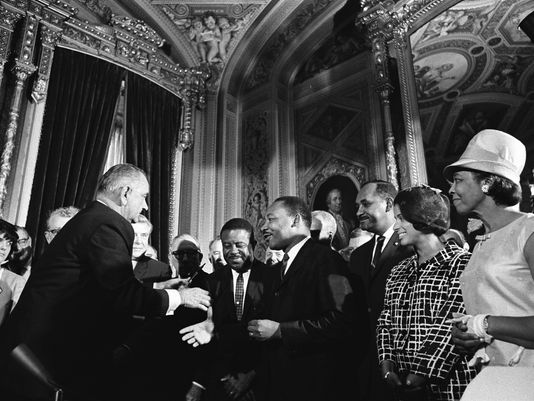
[President Lyndon Johnson at the signing of the Voting Rights Act of 1965 into law.]
Their 5-4 decision yesterday was in favor of striking down a key provision of the Voting Rights Act. That provision, Section 5 of the Act, required certain states and counties where voter discrimination against black Americans was rampant to get "pre-clearance" from the U.S. Justice Department for any changes in voting procedure. This was to prevent any attempts to suppress the vote among black voters. The states that are currently affected, as of 2008, are Alabama, Alaska, Arizona, Georgia, Louisiana, Mississippi, South Carolina, Texas, and Virginia. In addition, counties in California, Florida, North Carolina, and South Dakota, as well as townships in Michigan and New Hampshire are included under the Act.
The Act has been up for a vote four times since its initial enactment, on whether or not to uphold temporary sections and provisions of the Act. In 1970, 1975, 1982, and 2006, they have remained upheld. In the last congressional vote, it was upheld by a 390-33 vote in the House of Representatives and a unanimous 98-0 vote in the Senate. On July 27, 2006, then-President George W. Bush signed the Act's reenactment into law for another twenty-five years.
The Act should not have needed revisiting until the year 2031. Yesterday's vote stunted that.
The reasoning, if it could be summed up in one word, is that the provision, the very core of the Act, is "irrelevant". In his majority opinion, Chief Justice John Roberts wrote that things in this country regarding racism and racial voting discrimination have changed for the better, arguing that discrimination, which he openly admitted still exists, is far different today than it was in 1965. True, but has it changed enough? Notice he doesn't say racial voting discrimination no longer exists or is at such low levels as to deem it irrelevant, just that the provision of Act is irrelevant.
"While any racial discrimination in voting is too much, Congress must ensure that the legislation it passes to remedy the problem speaks to the current conditions," Roberts continued. He described the way the areas covered by the Act is determined as having "no logical relation to the present day". That's funny, it has been in Congress, the very body the Court said should be in charge of rectifying this, that has been where attempts to suppress the vote, including local governance. (Hint, Justice Roberts: while less, racism still exists.)
As soon as the Court's ruling came down, Texas Attorney General Greg Abbott announced that "the state's voter ID law will take effect immediately" and "redistricting maps passed by the Legislature may also take effect without approval from the federal government." (The same was attempted in Texas in 2011, and put in place and struck down by a federal court in 2012.) Redistricting maps, also known as gerrymandering, is one way of suppressing and intentionally swaying voter turnout.
Judge Roberts also cited how the Act states that "all changes to state election law -- however innocuous -- [are halted] until they have been precleared by federal authorities in Washington, D.C." It is the issue of something being innocuous that raises a red flag for me. Sometimes, it's not even on a statewide level, but on a local level, as in a county, that this gerrymandering takes place. One example is how Ohio Representative Dennis Kucinch lost his congressional seat in last year's midterm elections because of county redistricting.
Moving a polling place from one side of town to other or limiting voting hours (in an effort to "save money" or because of a "lack of volunteers") may seem relatively innocuous on the surface. For those who miss out on voting because of these moves -- maybe because of their work schedule or their inability to get, say, across town to the polling station for lack or limit of public transportation -- those actions are nothing less than disenfranchising. The smokescreen on how innocuous these moves are is becoming thinner and thinner.
In her dissenting opinion, Judge Ruth Bader Ginsburg noted how the overwhelming House and Senate votes in 2006 were an obvious sign that the country remains in favor of these provisions staying intact. She cited numerous legal cases in which attempts to deal with this issue piecemeal proved time and time again to be not sweeping enough and ultimately ineffective. She wrote that the Voting Rights Act of 1965 was enacted as a response to "a century's failure to fulfill the promise of the Fourteenth and Fifteenth Amendments of the U.S. Constitution."
In her expression of the role of the Supreme Court in this case, Judge Ginsburg notes that any evidence given for a reauthorization should show less evidence of what is at the center of the argument -- thus, the law or statute is working -- than when initial presentations were made. She wrote, "If the statute was working, there would be less evidence of discrimination, so opponents might argue that Congress should not be allowed to renew the statute. In contrast, if the statute was not working, there would be plenty of evidence of discrimination, but scant reason to renew a failed regulatory regime." Clearly, Section 5 has been in place for nearly a half-century and has been working for just as long.
What about if it wasn't in place, either by non-renewal or striking it down as unconstitutional? We will now find out, with Texas and Arizona, two states that had been affected by Section 5, leading the way.
Redistricting, voter ID cards, "voter protection", limiting or eliminating early voting, and voter rolls purging have been become commonplace enough to be called prevalent. Names like Texas Governor Rick Perry, Arizona Governor Jan Brewer, and Pennsylvania House Republican Leader Mike Turzai, among others, have usurped ... no, they have tried to usurp more important names and places. Names such as the Rev. Dr. Martin Luther King Jr., Rosa Parks, Thurgood Marshall, Julian Bond, Dick Gregory, James Bevel, and many others...and such places as Selma, Alabama; Montgomery, Alabama; Birmingham, Alabama; Memphis, Tennessee; and on the steps of the Lincoln Memorial in Washington, D.C.
And those who gave their lives in the fight for equal rights -- sometimes while intentionally standing up for them, some while doing ordinary non-protest activities -- can never be forgotten. Some of their names include Emmett Louis Till, Willie Edwards Jr., William Lewis Moore, Medgar Evers, Rev. James Reeb, Viola Gregg Liuzzo, Vernon Ferdinand Dahmer, and, of course, Rev. King.
As a white male, it is easy, and I would argue logical, to ask why I am being so emphatic on this issue. Fair enough. Here's why: civil rights are not just for blacks, but for everyone. When some faction of our numbers is denied equal rights, we are less of a nation. No, it doesn't affect my money, bank account, type of clothing, social status, etc., but civil rights are human rights. As a human being, it is illogical and inhumane to me to fight or argue against them. I'd want to do the same and would want the same to be done for me. Wouldn't you? It really is that simple to me.
Another idea I had for the title of this blog was "Term of the Day: IN VAIN" because it seems, at the onset, that all of the hard work, the loss of life, and the struggle itself were all in vain. Indeed, it seems that way...at least for now. The fight was never fully over. Major victories, like the Voting Rights Acts of 1965, have occurred, and those victories are great and necessary. The Supreme Court's ruling yesterday dismantled all of that struggle, and set us back forty-eight years.
Like with its vote in Citizens United v. Federal Election Commission in 2010, the Supreme Court has become the latest bastion for the dismantling of the United States of America. Such a distinction, which seems to have resided with only the Executive and Legislative branches, now resides in all three branches of our government. "[O]f the people, by the people, and for the people"...makes you wonder what people, exactly, are the powers that be thinking of.
The struggle is, unfortunately, renewed, expanded, and intensified. The fight goes on. There is a lot of catching up to do.
Terry
Wednesday, June 19, 2013
Word of the Day: TIME
Greetings, dear readers!
Today's blog posting is a special one for me because it marks the one year anniversary of this blog. It was on June 19, 2012, that I wrote the first entry on this blog: Phrase of the Day: TWO WRONGS DON'T MAKE A RIGHT. The subject was bullying and a case at an elementary school in Texas was highlighted. While not a prolific writer on this blog in terms of frequency of postings, in addition to bullying, issues covered have included immigration, mass shootings, xenophobia, euthanasia, and freedom & responsibility, among others.
I have had readers not only in the United States, where I am based, but in such varied locations as Sri Lanka, Vietnam, Israel, Germany, Brazil, Ukraine, France, United Kingdom, Poland, Japan, and Palestine, among many others. While I know that the Internet is worldwide, I am consistently blown away to the interest in my blog from persons around the world. To all of you who have read this blog, I say thank you so very much and please keep coming back. If you like this, please spread the word. We all have great thoughts; these are just mine.

The traditional gift for a first anniversary is paper, just as silver is for a twenty-fifth anniversary and gold is for a fiftieth anniversary. The modern gift for a first anniversary is clocks. Clocks, of course, relate to time. Time is many things to many people. To some (i.e. a scientist or, perhaps, a philosopher), it is simply a construct, not an actual reality. To others (i.e. a child waiting for summer vacation or wanting to be older), it doesn't go fast enough. To others still (i.e. that same child at the end of summer vacation, someone who is older in years, a parent watching a child grow up), it goes too quickly. I have experienced time as going both too quickly and too slowly...at different times, of course.
Having passed the half-century mark last year, I have found myself seeing time in an additional way. If you noticed in the right-hand column of this blog, as well as on my profile page, my description reads, "I am a full-time student in the course of Continuing Education at the School of Life." I would add to that, that time is my class period. Just as someone can learn something in a thirty-, forty-, or sixty-minute class, "time" is the umbrella term to describe the class period at the "School of Life".
In my first ten years, I knew a lot, at least according to my parents, but I had more to learn. At twenty years, what I learned increased exponentially from ten years, but the learning continued. The same can be said for my third and forth decades in comparison to decades past. I have been enjoying the learning continuing in my fifth decade, and look forward with great anticipation to what the future holds, what I will learn in the passing of time.
One of the greatest lessons I learned can be summed up in words of first century A.D. Roman philosopher and naturalist Pliny the Elder: "No one is wise at all times." Oh, how true!
I have also learned another great lesson that the knowledge I have gained over time is not a trophy to wave around or a staff with which I should stick people. In addition to meeting individuals who were more intelligent or less intelligent than I thought they were, I have learned that knowledge, like most things, has its time and place. The wisdom is to strike that balance between under-utilizing yourself and overwhelming others.
Time can also be a hindrance...not in terms of it going too slowly or too quickly, but in terms of personal growth and moving forward in life. This is most commonly described as being stuck in the past or living in the past. To those individuals, such phrases as What's done is done and The past is past are appropriate encouragements, if not always well-received, to moving forward in life. You cannot repeat the past (that is, to relive it over again), except to replicate it in the present...and that is just a repetition, not an initial occurrence.
Life itself is far more complex, of course, but we have examples all around us about moving on and the passing of time. Your teacher covers a section of a textbook for, say, a week. The test on that material is today. You are being tested in the present on what you learned in the past. The first time you shop at a new food store, you find where the dairy section and produce section are in that first trip. The next time you go, you know where they are. You are able to go to those sections without trying to find them today because of what you learned in your last visit.
"The past is prologue" is a famous line from William Shakespeare's play 'The Tempest'. Like the prologue of a book, what has been leads into what is and what will be. The passage from the play (Act II, Scene I) is spoken by Antonio, Prospero's brother, and reads:
She that is queen of Tunis; she that dwells
Ten leagues beyond man's life; she that from Naples
Can have no note, unless the sun were post --
The man i' the moon's too slow -- till new-born chins
Be rough and razorable; she that -- from whom?
We all were sea-swallow'd, though some cast again,
And by that destiny to perform an act
Whereof what's past is prologue, what to come
In yours and my discharge.
It is wise to not get caught up or, perhaps more so, anchored in any period of time in your life. We live in the present, yes, so we have to be in the moment, but we cannot wish for things to stay the same forever if we like how things are; they won't stay the same. We cannot become anchored in the past, for we will never grow as individuals. We cannot even get anchored in the future -- and I'm not talking about simply making future plans or putting money away for retirement -- for we will not always allow ourselves to learn what we will need to know.
At the "School of Life", the past teaches the present; the present is the past's pupil. You live out now from what you learned then. The future is the present's pupil -- the present will, at that point, be the past, of course -- and you will live out then from what you learn now. Learn everything in its due time. Life live in its due time. Time will pass in its due time.
Terry
Today's blog posting is a special one for me because it marks the one year anniversary of this blog. It was on June 19, 2012, that I wrote the first entry on this blog: Phrase of the Day: TWO WRONGS DON'T MAKE A RIGHT. The subject was bullying and a case at an elementary school in Texas was highlighted. While not a prolific writer on this blog in terms of frequency of postings, in addition to bullying, issues covered have included immigration, mass shootings, xenophobia, euthanasia, and freedom & responsibility, among others.
I have had readers not only in the United States, where I am based, but in such varied locations as Sri Lanka, Vietnam, Israel, Germany, Brazil, Ukraine, France, United Kingdom, Poland, Japan, and Palestine, among many others. While I know that the Internet is worldwide, I am consistently blown away to the interest in my blog from persons around the world. To all of you who have read this blog, I say thank you so very much and please keep coming back. If you like this, please spread the word. We all have great thoughts; these are just mine.

The traditional gift for a first anniversary is paper, just as silver is for a twenty-fifth anniversary and gold is for a fiftieth anniversary. The modern gift for a first anniversary is clocks. Clocks, of course, relate to time. Time is many things to many people. To some (i.e. a scientist or, perhaps, a philosopher), it is simply a construct, not an actual reality. To others (i.e. a child waiting for summer vacation or wanting to be older), it doesn't go fast enough. To others still (i.e. that same child at the end of summer vacation, someone who is older in years, a parent watching a child grow up), it goes too quickly. I have experienced time as going both too quickly and too slowly...at different times, of course.
Having passed the half-century mark last year, I have found myself seeing time in an additional way. If you noticed in the right-hand column of this blog, as well as on my profile page, my description reads, "I am a full-time student in the course of Continuing Education at the School of Life." I would add to that, that time is my class period. Just as someone can learn something in a thirty-, forty-, or sixty-minute class, "time" is the umbrella term to describe the class period at the "School of Life".
In my first ten years, I knew a lot, at least according to my parents, but I had more to learn. At twenty years, what I learned increased exponentially from ten years, but the learning continued. The same can be said for my third and forth decades in comparison to decades past. I have been enjoying the learning continuing in my fifth decade, and look forward with great anticipation to what the future holds, what I will learn in the passing of time.
One of the greatest lessons I learned can be summed up in words of first century A.D. Roman philosopher and naturalist Pliny the Elder: "No one is wise at all times." Oh, how true!
I have also learned another great lesson that the knowledge I have gained over time is not a trophy to wave around or a staff with which I should stick people. In addition to meeting individuals who were more intelligent or less intelligent than I thought they were, I have learned that knowledge, like most things, has its time and place. The wisdom is to strike that balance between under-utilizing yourself and overwhelming others.
Time can also be a hindrance...not in terms of it going too slowly or too quickly, but in terms of personal growth and moving forward in life. This is most commonly described as being stuck in the past or living in the past. To those individuals, such phrases as What's done is done and The past is past are appropriate encouragements, if not always well-received, to moving forward in life. You cannot repeat the past (that is, to relive it over again), except to replicate it in the present...and that is just a repetition, not an initial occurrence.
Life itself is far more complex, of course, but we have examples all around us about moving on and the passing of time. Your teacher covers a section of a textbook for, say, a week. The test on that material is today. You are being tested in the present on what you learned in the past. The first time you shop at a new food store, you find where the dairy section and produce section are in that first trip. The next time you go, you know where they are. You are able to go to those sections without trying to find them today because of what you learned in your last visit.
"The past is prologue" is a famous line from William Shakespeare's play 'The Tempest'. Like the prologue of a book, what has been leads into what is and what will be. The passage from the play (Act II, Scene I) is spoken by Antonio, Prospero's brother, and reads:
She that is queen of Tunis; she that dwells
Ten leagues beyond man's life; she that from Naples
Can have no note, unless the sun were post --
The man i' the moon's too slow -- till new-born chins
Be rough and razorable; she that -- from whom?
We all were sea-swallow'd, though some cast again,
And by that destiny to perform an act
Whereof what's past is prologue, what to come
In yours and my discharge.
It is wise to not get caught up or, perhaps more so, anchored in any period of time in your life. We live in the present, yes, so we have to be in the moment, but we cannot wish for things to stay the same forever if we like how things are; they won't stay the same. We cannot become anchored in the past, for we will never grow as individuals. We cannot even get anchored in the future -- and I'm not talking about simply making future plans or putting money away for retirement -- for we will not always allow ourselves to learn what we will need to know.
At the "School of Life", the past teaches the present; the present is the past's pupil. You live out now from what you learned then. The future is the present's pupil -- the present will, at that point, be the past, of course -- and you will live out then from what you learn now. Learn everything in its due time. Life live in its due time. Time will pass in its due time.
Terry
Wednesday, June 12, 2013
Word of the Day: BALANCE
The recent leak of inforrmation regarding the efforts of the NSA (National Security Agency) to gather information on U.S. citizens, referred to as "data collection programs", has caused a huge stir in Washington and across the country. The plan, intended to gather information on terroristic activities, caused such a stir because the information gathered has not been solely related to actual persons involved in terrorism, but on vast amounts of the American public in general.
The leak to the British newspaper The Guardian, a result of the effort of Edward Snowden, who worked as a contractor for the NSA, initially revealed that phone company giant Verizon has been complacent in providing phone records to the NSA. Those phone records were as detailed as every call you make, every person you call, how often, how long your calls are, etc. (Mind you, this was not of calls made to/from known terrorist cells or overseas, but all calls.) Then, news broke of Internet giants also providing personal information to the NSA.
In addition to Yahoo!, Apple, and Facebook, Google is one of those giants. As this blogging service, Blogger, is owned by Google, I suspect that any views of dissent, as mine will be, might be suspect.
Ever since the terrorist attacks on September 11, 2001, the illusion of we would never be attacked on our own land has been broken. The idea of security, naturally, took a priority. Over the eleven-and-a-half years since then, however, how security has been approached has been, at the very least, suspicious, in and of itself. In my opinion, those efforts have been mixed, at best.
More specific to the NSA issue, there is the standard argument of If you have nothing to hide, then what's the problem? Well, frankly, the vast majority of American citizens don't have anything to hide, so that is an absolutely valid question. In fact, if the vast majority of Americans did have some serious things to hide, then the argument of hiding could be made en masse, and perhaps -- perhaps -- could this program be seen in a somewhat better light.
But the uproar does not stem from a desire to hide something; it stems from fear -- fear that this is just one more attack on our freedom and liberties under a guise of national security. While trying to hide something is a pretty powerful motivator, especially if what you're hiding is illegal or immoral, fear is an even more powerful motivator. Hiding something illegal from the government is a poor reason; fear of one's freedoms and liberties continually being eroded is a righteous reason.
If what has been happening in this country for the past eleven-plus years with the initiation of the Patriot Act was made into a movie, it might well be called 'King James Redux'.
One of the ways that the fear that many Americans share became evident in a story that aired yesterday on the NBC morning show 'Today'. It was revealed that sales on Amazon.com of the George Orwell classic '1984', the book in which the term "Big Brother" was coined, has increased more than 6,000% in just twenty-four hours since the news of the NSA program became public. (In the video in the above link, it is stated that the increase is 5,800%, but other sources have since listed the jump as more than 6,000%.) That means that, if '1984' had been selling on Amazon at a pace of around 100 books per week, in that twenty-four hour period, the sales of the same book would have inflated to around 6,100 copies.
Here in America, Big Brother is, and has been, watching.
In that same 'Today' article, President Obama mentions Orwell's book, and says that they have struck a balance in the implementation of these programs. President Obama's optimism is not shared by me.
For example, let's say that I am posting on Facebook. One of the topics covered in my posting is the recent bombings in Boston. Let's go further and say that one of the things I say is the following: "It's horrible that they got away with the bombing, and they were planning more, but it was good that the President went there." (Some of you might be a step of ahead of me as far as where I am going with this.) The statement seems fairly innocuous, doesn't it? To most individuals, it is an innocuous statement. However, what if someone from the NSA sees this? Certain buzzwords in that innocuous statement might raise a red flag:"It's horrible that they got away with the bombing, and they were planning more, but it was good that the President went there."
Now, let's say that I post that in a couple of places on Facebook, write that in a few E-mails, and mention it a few times on the phone. People who know me well enough personally would know that the reason is that it was a hot topic at the time. How would people who do not know me personally know the same?
In his 1999 HBO special, 'You are All Diseased', the late comedian George Carlin, speaking more specifically about airport security, although I think it can be extrapolated to a broader scale, commented, "[Americans are] always willing to trade away a little of their freedom in exchange for the feeling -- the illusion -- of security." His observation is correct because it has been happening more and more, over and over again. It seems as though people believe that liberty is in opposition to security.
The question here is how can a balance be struck between security and liberty? If the scales continue to tip in the direction of security (real or an illusion), how far are we willing to let it tip that way? Time will tell if this latest political hoodwinking is, at last, the turning point.
Terry
The leak to the British newspaper The Guardian, a result of the effort of Edward Snowden, who worked as a contractor for the NSA, initially revealed that phone company giant Verizon has been complacent in providing phone records to the NSA. Those phone records were as detailed as every call you make, every person you call, how often, how long your calls are, etc. (Mind you, this was not of calls made to/from known terrorist cells or overseas, but all calls.) Then, news broke of Internet giants also providing personal information to the NSA.
In addition to Yahoo!, Apple, and Facebook, Google is one of those giants. As this blogging service, Blogger, is owned by Google, I suspect that any views of dissent, as mine will be, might be suspect.
Ever since the terrorist attacks on September 11, 2001, the illusion of we would never be attacked on our own land has been broken. The idea of security, naturally, took a priority. Over the eleven-and-a-half years since then, however, how security has been approached has been, at the very least, suspicious, in and of itself. In my opinion, those efforts have been mixed, at best.
More specific to the NSA issue, there is the standard argument of If you have nothing to hide, then what's the problem? Well, frankly, the vast majority of American citizens don't have anything to hide, so that is an absolutely valid question. In fact, if the vast majority of Americans did have some serious things to hide, then the argument of hiding could be made en masse, and perhaps -- perhaps -- could this program be seen in a somewhat better light.
But the uproar does not stem from a desire to hide something; it stems from fear -- fear that this is just one more attack on our freedom and liberties under a guise of national security. While trying to hide something is a pretty powerful motivator, especially if what you're hiding is illegal or immoral, fear is an even more powerful motivator. Hiding something illegal from the government is a poor reason; fear of one's freedoms and liberties continually being eroded is a righteous reason.
If what has been happening in this country for the past eleven-plus years with the initiation of the Patriot Act was made into a movie, it might well be called 'King James Redux'.
One of the ways that the fear that many Americans share became evident in a story that aired yesterday on the NBC morning show 'Today'. It was revealed that sales on Amazon.com of the George Orwell classic '1984', the book in which the term "Big Brother" was coined, has increased more than 6,000% in just twenty-four hours since the news of the NSA program became public. (In the video in the above link, it is stated that the increase is 5,800%, but other sources have since listed the jump as more than 6,000%.) That means that, if '1984' had been selling on Amazon at a pace of around 100 books per week, in that twenty-four hour period, the sales of the same book would have inflated to around 6,100 copies.
Here in America, Big Brother is, and has been, watching.
In that same 'Today' article, President Obama mentions Orwell's book, and says that they have struck a balance in the implementation of these programs. President Obama's optimism is not shared by me.
For example, let's say that I am posting on Facebook. One of the topics covered in my posting is the recent bombings in Boston. Let's go further and say that one of the things I say is the following: "It's horrible that they got away with the bombing, and they were planning more, but it was good that the President went there." (Some of you might be a step of ahead of me as far as where I am going with this.) The statement seems fairly innocuous, doesn't it? To most individuals, it is an innocuous statement. However, what if someone from the NSA sees this? Certain buzzwords in that innocuous statement might raise a red flag:"It's horrible that they got away with the bombing, and they were planning more, but it was good that the President went there."
Now, let's say that I post that in a couple of places on Facebook, write that in a few E-mails, and mention it a few times on the phone. People who know me well enough personally would know that the reason is that it was a hot topic at the time. How would people who do not know me personally know the same?
In his 1999 HBO special, 'You are All Diseased', the late comedian George Carlin, speaking more specifically about airport security, although I think it can be extrapolated to a broader scale, commented, "[Americans are] always willing to trade away a little of their freedom in exchange for the feeling -- the illusion -- of security." His observation is correct because it has been happening more and more, over and over again. It seems as though people believe that liberty is in opposition to security.
The question here is how can a balance be struck between security and liberty? If the scales continue to tip in the direction of security (real or an illusion), how far are we willing to let it tip that way? Time will tell if this latest political hoodwinking is, at last, the turning point.
Terry
Subscribe to:
Posts (Atom)